
Protective Packaging for Machinery: How Do Industrial Goods Arrive Damage-Free?
· by Editorial team
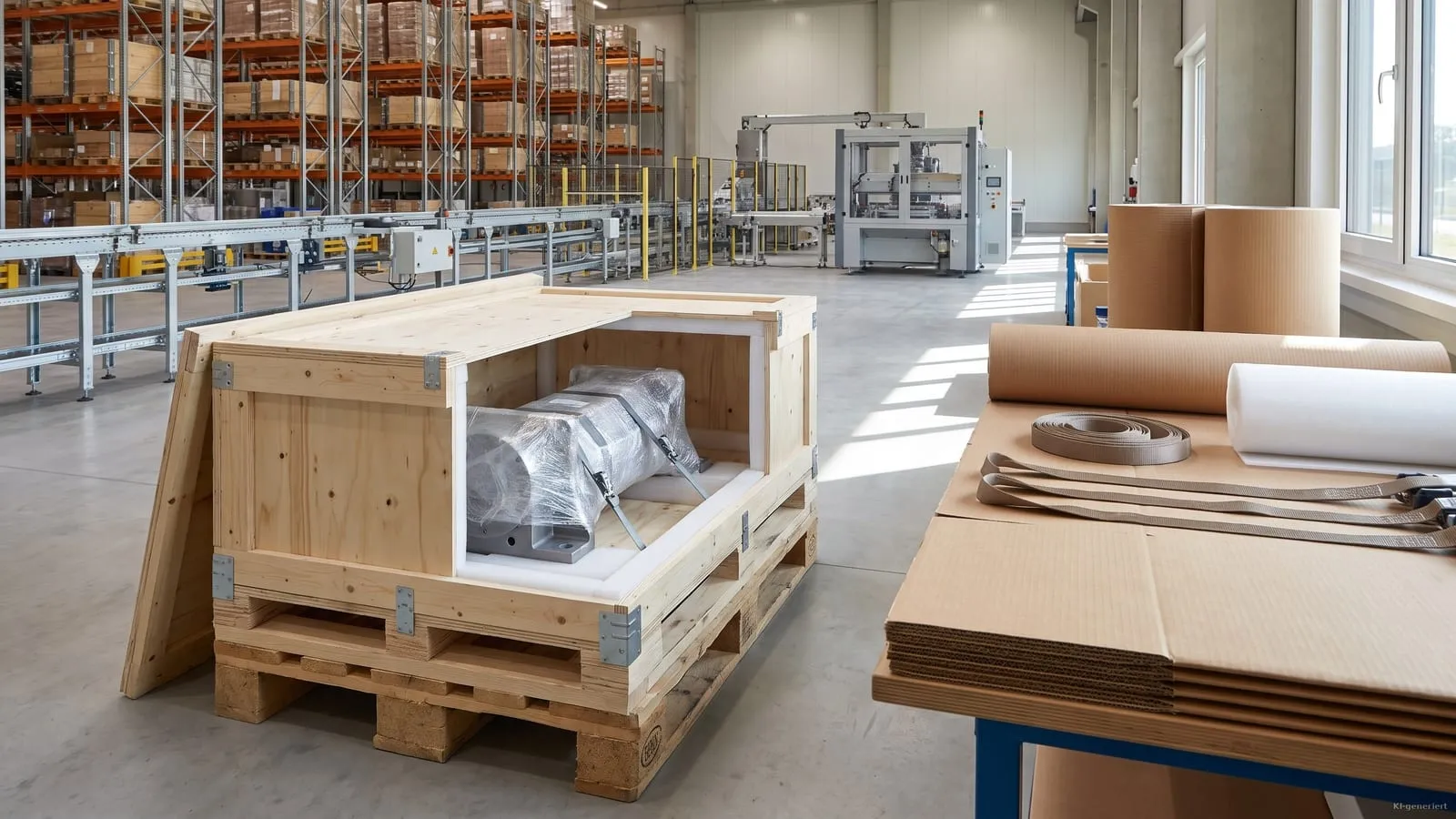
Protective packaging for machinery combines four elements: a load-bearing outer packaging, retention and cushioning inside, corrosion protection and durable marking. For industrial goods to arrive damage-free, these elements must be designed for the stresses of the route and the load must be secured in the vehicle or container.
Under German freight law, responsibility generally lies with the sender: Section 411 of the German Commercial Code (§ 411 HGB) obliges them to pack the goods, as far as necessary, so that they are protected against loss and damage. If they use pallets or containers, they must stow and secure the goods on or in them ready for transport. Questions of liability in individual cases also depend on contracts and international regulations; this article is not legal advice. In mechanical engineering, industrial packaging is therefore part of the planning from the outset.
How do you avoid transit damage to machinery?
Transit damage arises above all from mechanical, climatic and biotic stresses. The Transport Information Service (TIS) of the insurers' association GDV names three countermeasures: packaging designed for the stresses involved, appropriate load securing and correct moisture management.
How strong the forces are depends on the mode of transport. According to the packing guidelines of the CTU Code, which the TIS reproduces, road transport involves an acceleration of 1 g in the direction of travel. At sea, 0.8 g acts laterally, that is 80 % of the weight force. With shunting impacts in rail transport, the goods must be secured against up to four times their weight force.
In addition, there is repetition: on the road, the maximum load usually occurs only once. At sea, the lateral movements, for example between Hamburg and New York, are repeated several tens of thousands of times. Protective packaging that survives a lorry journey is therefore not automatically seaworthy.
How do you pack a machine correctly?
- Prepare it cleanly: do not touch metal parts with bare hands before preserving them. According to Marcus Kirschner, Managing Director of the German Federal Association of Wooden Packaging, Pallets, Export Packaging (HPE), even grease marks can jeopardise corrosion protection.
- Choose the outer packaging: suitable packaging includes wooden crates, slatted crates and constructions made of corrugated and solid board. According to the TIS, packaging wood may have a water content of no more than 12 to 18 %, and the crate lid should withstand a stacking compression pressure of 1 t/m².
- Plan for clearance: at least 30 mm belongs between the machine and the crate wall, and at least 50 mm for sensitive parts and climate packaging.
- Retain and cushion: expanding foam cushions are suitable for components with complex geometry, while suspension packaging holds sensitive assemblies in position without slipping. Spare parts and accessories travel in custom boxes.
- Mark it durably: for machine and shipping data, metal plates are more suitable than plastic sleeves. According to the TIS, the latter are "easily destroyed during transport and handling by damage and moisture".
What applies to packaging for heavy parts?
If a heavy machine with a small contact area stands in a container, it needs a load-distributing base made of squared timbers, known as dunnage. Otherwise the container floor is overloaded at individual points.
The load is secured directly with lashing chains or wire ropes, by form fit over other cargo or timber bracing, or by friction through tie-down lashing. When attaching loads, the spreading angle should remain below 60°.
For sea transport, the HPE divides the requirements into three parts: corrosion protection against sea air, securing the packed goods in or on the packaging, and securing the packaging in the container. Good cushioning in the crate therefore does not replace load securing.
Related to this article: Verpackungen für den Maschinenbau | FUCHSPACK Sicherer Versand für schwere Güter & Präzisionsbauteile. Robuste Polstersysteme für den Maschinenbau. Prozesssicher & effizient. Jetzt informieren! More about Verpackungen für den Maschinenbau | FUCHSPACK →
Which corrosion protection belongs in the protective packaging?
According to the TIS, corrosion begins at around 40 % relative humidity and increases sharply above 60 %. In climate or sealed packaging, a target value below 40 to 50 % therefore applies. Three methods are available:
- Protective coating: oils, waxes or water- or solvent-based protective agents separate the metal surface from moisture, salts and acids.
- Desiccant: the packed goods are sealed together with desiccant bags into a water-vapour-tight barrier film, such as aluminium composite film. The bags hang at the top, well ventilated and without contact with the metal.
- VCI: a volatile corrosion inhibitor deposits as a protective film on metal. Airtight sealing is not necessary, but the method is only suitable for purely metallic objects. When handling it, TRGS 615 must be observed.
With the desiccant method, the position of the wood matters: moist wood inside the barrier layer is the biggest supplier of moisture. In the TIS calculation example, a machine export to Brazil over 100 days, the requirement falls from 8,346 to 246 desiccant units if the wooden supports lie outside the film.
When do you need ESD protective packaging?
With electronic assemblies, protection against electrostatic discharge is added. DIN EN 61340-5-1 describes an ESD control programme for components that are sensitive from 100 V (Human Body Model), 200 V (Charged Device Model) or 35 V on isolated conductors. The 2017 edition was replaced by a 2024 version.
The 2017 edition already no longer contains any packaging requirements; these are set out in IEC 61340-5-3. It defines the properties of ESD protective packaging for production, transport and storage. With the 2022 edition, the requirement for shielding against electrostatic discharge was tightened from 50 nJ to 20 nJ. The standard does not cover protection against electromagnetic interference (EMI) or pulses (EMP).
Cushioning and retention solve the impact problem, not the electrostatic one. With every material, therefore, check whether it is designated for ESD-sensitive components.
Frequently asked questions
Does every wooden crate for export need an IPPC stamp?
No. ISPM 15 applies to wooden packaging over 6 mm thick, such as pallets, crates and dunnage. Wood-based materials such as plywood, chipboard, OSB and MDF are exempt. Affected wood is, for example, heated to at least 56 °C throughout the entire cross-section for at least 30 minutes and durably marked on at least two opposite sides.
How long does VCI protect against corrosion?
The TIS names an effective duration of up to two years. This is a guide value, not a guarantee: the actual protection period depends on packaging, climate and product.
Are air cushions sufficient for machine parts?
In practice, air cushions serve above all as void fill. Heavy or angular components additionally need retention. Which cushioning is suitable depends on weight, shape and route.
Are you planning to ship machinery, assemblies or spare parts? With our industry solutions, we develop tailored packaging concepts for your protection and your workflow. Get in touch with us and briefly describe the packed goods, weight and route.
Transparency note: This article was created with AI assistance and reviewed by our editorial team. The article image is AI-generated.