
Cushioning material in shipping: How do you protect goods with less material?
· by Editorial team
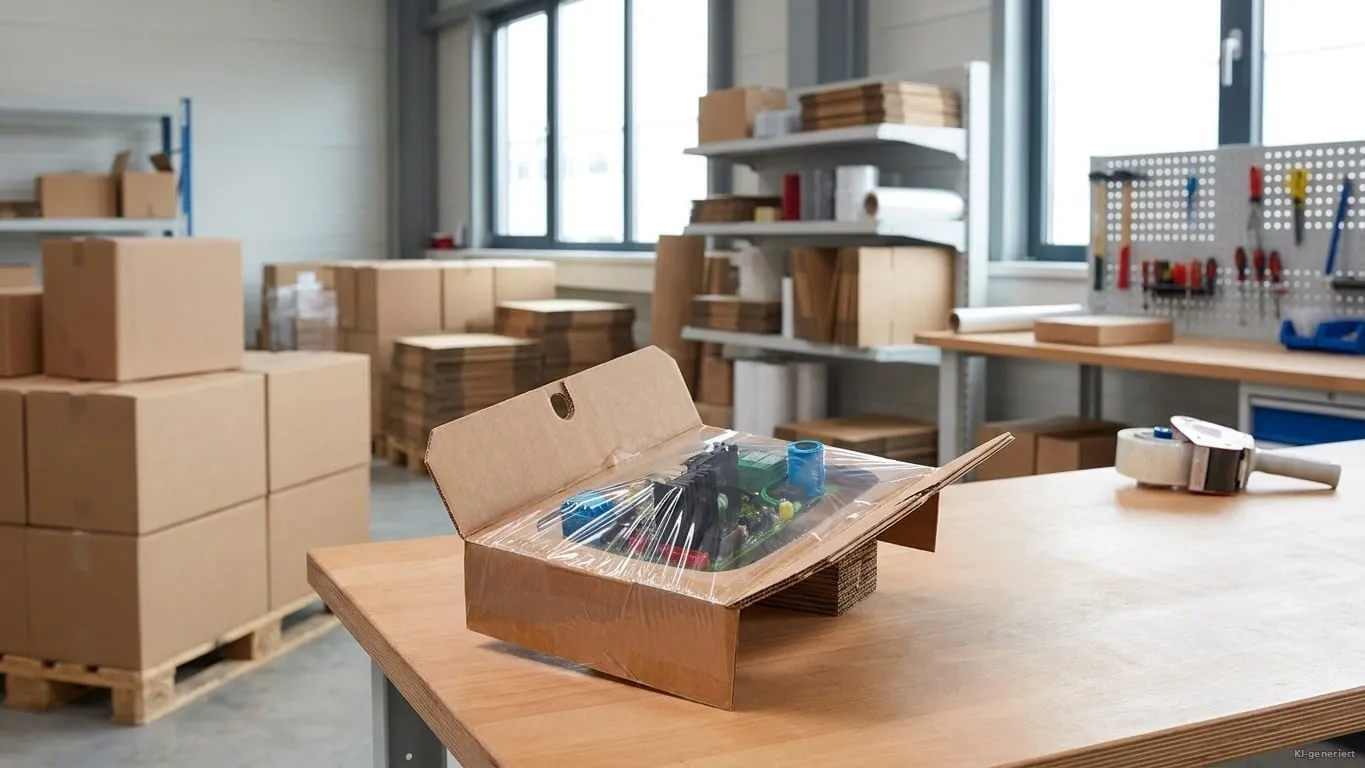
Less cushioning material is enough when the box fits the product and the cushion sits precisely where it absorbs impacts. Void fill that only compensates for empty space will itself count as void under the EU Packaging and Packaging Waste Regulation (PPWR). The right box size therefore comes first.
How do you cushion a parcel correctly?
The basic rules are set out in the packaging guidelines from DHL: the shipped goods should be cushioned on all sides. All cavities, including the lid area, should be completely filled so that the box is not crushed.
Heavy items belong at the bottom, light items at the top, sensitive items on the inside. Typical mistakes include direct contact between the contents and the outer packaging, protruding parts and too little cushioning.
For saving material, the first point is central: every cavity must be filled. The less cavity the box leaves, the less void fill you need inside the parcel.
Which cushioning material suits which shipped goods?
DHL identifies moulded cushions as the recommended cushioning material and also mentions air cushion bags and loose void fill. Loose-fill cushioning made from starch is considered only conditionally recommendable. For wrapping, bubble wrap, roll corrugated and machine-crumpled kraft paper are suitable.
The choice depends on whether you want to secure, wrap or fill cavities around a product:
- Securing: foam cushions expand and, as moulded cushions, adapt to complex geometries. Suspension packaging holds sensitive products in place without them slipping.
- Wrapping: airbag packaging protects items such as laptops or smartphones all round with air bags.
- Filling cavities: air cushion systems produce air cushions or air cushion mats directly at the packing station.
- Cushioning material made from paper: paper cushioning systems produce paper cushions in the required quantity and size at the packing station, suitable for cushioning, wrapping and filling.
Is paper cushioning always the more environmentally friendly choice?
That cannot be said across the board. Matuštík and Kočí (2020) examined parcels from a retailer of cosmetics and household goods in a life cycle assessment. In this case, cushioning with plastic cushions performed better from an environmental perspective than cushioning with paper. However, the biggest environmental burden came from electricity consumption at the logistics centre. Energy efficiency and good use of space are therefore important levers.
A systematic review by Dolci and colleagues (2025) evaluates 53 peer-reviewed life cycle assessment studies from 2019 to 2023. Paper often performed better than plastic there, but conventional plastic was frequently not the most environmentally harmful choice. A high weight worsens the environmental balance.
Therefore compare cushioning materials in relation to your shipped goods and, alongside the material, pay attention to quantity, weight and box size.
Why does saving material start with the box?
Until 11 August 2026, § 4 of the German Packaging Act (Verpackungsgesetz) required the volume and mass of packaging to be limited to the minimum appropriate for safety, hygiene and consumer acceptance. Since 12 August 2026, the Packaging Law Implementation Act (Verpackungsrecht-Durchführungsgesetz, VerpackDG) has replaced the German Packaging Act. The minimum requirement continues to apply there almost word for word (§ 12 (3) VerpackDG). At the same time, the EU Packaging and Packaging Waste Regulation (PPWR) applies directly, with some of its obligations taking effect only later. Two rules from the PPWR are important for cushioning material in shipping:
- Minimum requirement under EU law: From 1 January 2030, the weight and volume of packaging must be reduced to the minimum necessary for its function (Art. 10 (1)). Packaging whose features serve only to increase the perceived volume of the product is also prohibited, for example double walls, false bottoms or unnecessary layers (Art. 10 (2)). Exemptions apply to certain protected designs, trademarks and geographical indications.
- Void space: Anyone filling e-commerce, transport or grouped packaging must limit the empty space ratio to no more than 50 % (Art. 24). Space filled with paper, air cushions, bubble wrap, foam or polystyrene chips counts as void here. Exempt are, among others, sales packaging that also serves as e-commerce packaging.
More void fill therefore does not improve the empty space ratio; that is only achieved with a suitable box. The 50 % limit applies at the earliest on 1 January 2030 or three years after the implementing act on the calculation method, whichever comes later. This method is to be set by the EU Commission by 12 February 2028. With made-to-measure corrugated boxes you align the box to the shipped goods rather than the other way round.
The German federal cabinet adopted the draft for the VerpackDG in February 2026. This overview reflects the legal position as of October 2026 and does not replace legal advice.
Related to this article: Schaumpolster & Schaumverpackungen nach Maß INSTAPAK® Schaumverpackungen für maximalen Produktschutz. Expandierende Polster für komplexe Geometrien. Effizient, sicher & stoßfest. Hier informieren! More about Schaumpolster & Schaumverpackungen nach Maß →
How do you save cushioning material without weakening protection?
These steps help in practice:
- Adjust the box size. Less cavity means less material that has to be filled.
- Secure instead of filling. Moulded cushions or suspension packaging hold the goods in place, rather than loose material filling a large cavity.
- Produce cushions on demand. Systems that produce cushions only at the packing station make it easier to use only as much per parcel as the goods require.
- Question additional shipping packaging. The German Environment Agency (Umweltbundesamt) considers it possible that by 2030 almost a third of products will manage without additional shipping packaging. Check which of your products are suitable for this.
- Test before switching. Trial shipments show whether the new combination of box and cushion protects your goods.
How do you find the right cushioning material for your shipping?
Which combination of box and cushion fits depends on the weight, shape and sensitivity of your goods as well as on your packing process. For online retailers we offer dedicated shipping solutions for online retail, and suitable industry solutions for mechanical engineering, automotive, medical technology or electronics.
Get in contact with our packaging specialists and briefly describe what you ship and what conditions apply. Together we will check whether and where you can save cushioning material without neglecting the protection of your goods.
Frequently asked questions
Has the 50 % limit on void space applied since August 2026?
No. The requirements of the EU Packaging and Packaging Waste Regulation (PPWR) have applied since August 2026, but the void limit takes effect at the earliest on 1 January 2030. The later point in time is decisive: this date or three years after the implementing act on the calculation method.
How much distance do the goods need from the box wall?
DHL does not state a fixed value in centimetres. What matters is that the contents do not directly touch the outer packaging and are cushioned on all sides. How much cushioning is necessary depends in practice on the weight and sensitivity of the goods.
Which cushioning material is suitable for sensitive electronics?
Electronics should be protected all round and should not slip inside the box. Airbag packaging or suspension packaging are options for this. For laptops, smartphones and hi-fi devices we offer dedicated solutions for multimedia and electronics.
Transparency note: This article was created with AI assistance and reviewed by our editorial team. The article image is AI-generated.