
The Hidden Margin Trap: How Product Protection Cuts Your Returns Rate
· by Editorial team
Returns are often caused not by the product itself but by transit damage on the way to the customer. If you consistently match product protection to the shipped goods, you noticeably reduce damaged consignments, and with them the number of returns. Optimal cushioning, made-to-measure boxes and the right retention therefore have a direct effect on your margin.
Why is the returns rate an invisible margin trap?
Every return costs you twice: you not only lose the revenue from the original consignment, you also pay for the return shipment, inspection, reconditioning and often for replacement goods. These follow-on costs rarely appear as a separate item in your calculation. They hide in logistics, staffing and service budgets. That is precisely why the link between inadequate product protection and a shrinking margin so often goes unnoticed.
A considerable share of avoidable returns can be traced back to transit damage: scratched surfaces, bent components, broken corners. The customer receives a product that does not match the condition they expected, and sends it back. The actual trigger lies not in the product but in the journey to the customer. If you secure that journey, you tackle the root cause instead of managing the symptoms in returns handling.
Product protection is not merely a cost factor. It is an investment that pays off through falling returns rates, fewer replacement deliveries and more satisfied recipients. The more sensitive or valuable your goods, the greater the leverage.
How does the right product protection reduce your returns rate?
The decisive factor is that the packaging matches the product, not the other way round. Three levels interlock here: the outer shell, the cushioning and the retention inside the box.
It starts with the outer shell. A box that is too large or too unstable lets the contents shift and gives way under stacking pressure. Made-to-measure shipping boxes and custom boxes reduce empty space from the outset and lay the foundation for safe transit. Less void means less movement, and less movement means less damage.
Inside the box, the cushioning is what counts. For void fill, air cushion systems are well suited because they fill volume quickly, while paper cushioning offers a sustainable, readily recyclable alternative. For products with complex geometries or particularly sensitive edges, foam packaging is the natural choice: it adapts to the shape of the product and absorbs impacts precisely where needed.
The third level is retention. If a product moves inside the box, exactly the kind of micro-damage arises that later leads to a complaint. Suspension and retention packaging holds the product securely in place without squeezing it: ideal for sensitive goods that must neither shift nor come under pressure.
Which solution suits which shipped goods?
Not every product needs the same protection. The key is to align the effort with the risk, so that you avoid both under-packaging and costly over-packaging.
For sensitive technology such as laptops, smartphones or delicate electronics, airbag packaging with the UNIQBAG system provides shock-proof all-round protection that embeds the product in a cushion of air. For high-value or irregularly shaped goods, form-fitting cushioning plays to its strengths, because it moulds itself exactly to the contours and leaves no unprotected contact points.
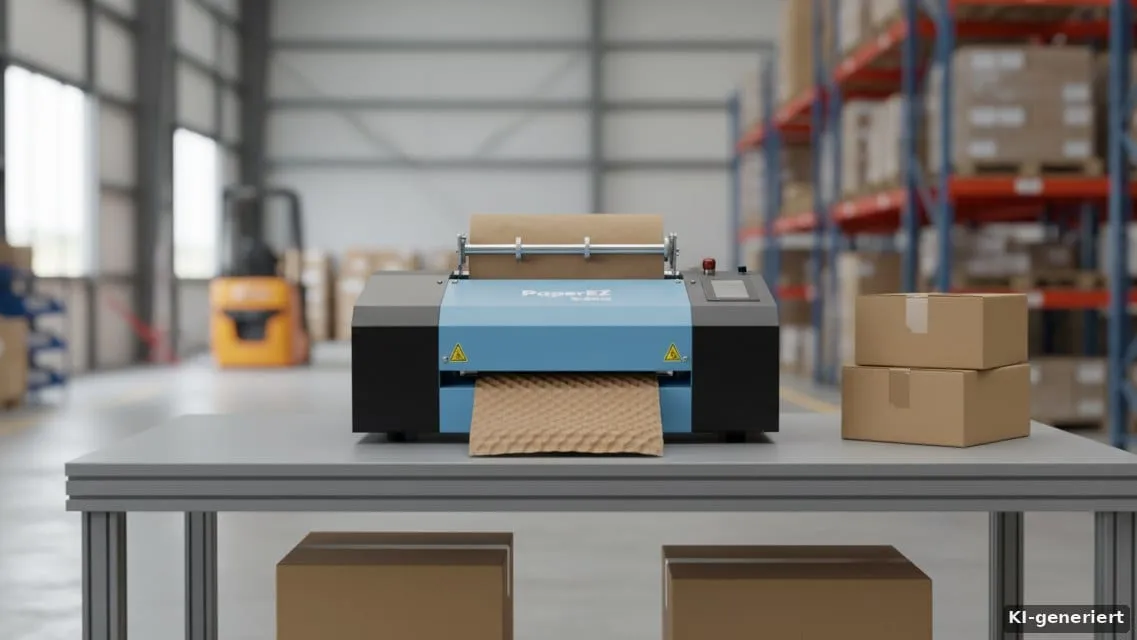
For shippers with high throughput, packing speed at the packing station also counts. Systems that produce cushioning material directly on site combine a fast workflow with consistent protective quality, so protection remains constant even at peak load instead of slipping under time pressure. This is exactly what matters during periods of high shipping volume, because experience shows that this is when hastily packed, and therefore poorly protected, consignments pile up.
In practice the answer is rarely a single solution but a sensible combination: the right box as a stable shell, the right cushioning material for the void and reliable retention for sensitive parts. This coordination decides whether a consignment arrives undamaged or comes back as a return.
Matching product: Custom foam cushioning & foam packaging | FUCHSPACK INSTAPAK® foam packaging for maximum product protection. Expanding cushions for complex geometries. Efficient, safe & shock-resistant. Find out more here! More about custom foam cushioning & foam packaging | FUCHSPACK →
Related to this article: Schaumpolster & Schaumverpackungen nach Maß | FUCHSPACK INSTAPAK® Schaumverpackungen für maximalen Produktschutz. Expandierende Polster für komplexe Geometrien. Effizient, sicher & stoßfest. Hier informieren! More about Schaumpolster & Schaumverpackungen nach Maß | FUCHSPACK →
Is switching worthwhile economically?
The calculation becomes tangible as soon as you set the follow-on costs of a return against the additional cost of better protection. Every return avoided saves return shipping, inspection effort and possible replacement goods, and ties up less staff in customer service. Added to this is an effect that is hard to quantify but clearly felt: recipients who receive their goods in perfect condition remain more satisfied and are more likely to buy again.
The first step is an honest stocktake: which products are most frequently returned damaged, and where is the weak point, in the box, the cushioning or the retention? This analysis almost always reveals a clear starting point where a great deal can be achieved with comparatively little effort.
Frequently asked questions about product protection and the returns rate
Doesn't better product protection simply mean higher packaging costs?
In the short term, the material cost per consignment may rise. However, these additional costs are offset by the follow-on costs saved with every return avoided: return shipping, inspection and replacement delivery often weigh far more heavily than the extra cushioning material.
How can I tell that my returns are due to transit damage?
A look at the return reasons helps: if damage, scratches or breakage are frequent, the cause usually lies in the shipping route. Inspect returned consignments and check whether products have shifted inside the box or were insufficiently cushioned.
Do I have to switch all of my packaging at once?
No. It makes sense to start with the products that most frequently come back damaged. That way you secure the greatest leverage first and can extend the changeover step by step to further product ranges.
What role does box size play?
A major one. A box that is too large lets the contents shift and requires more void fill; one that is too small increases the pressure on the product. Made-to-measure boxes reduce empty space and create the basis for effective cushioning.
Transparency note: This article was created with AI assistance and reviewed by our editorial team. The article image is AI-generated.