
Optimising the packaging process: what can AI and sensors do?
· by Editorial team
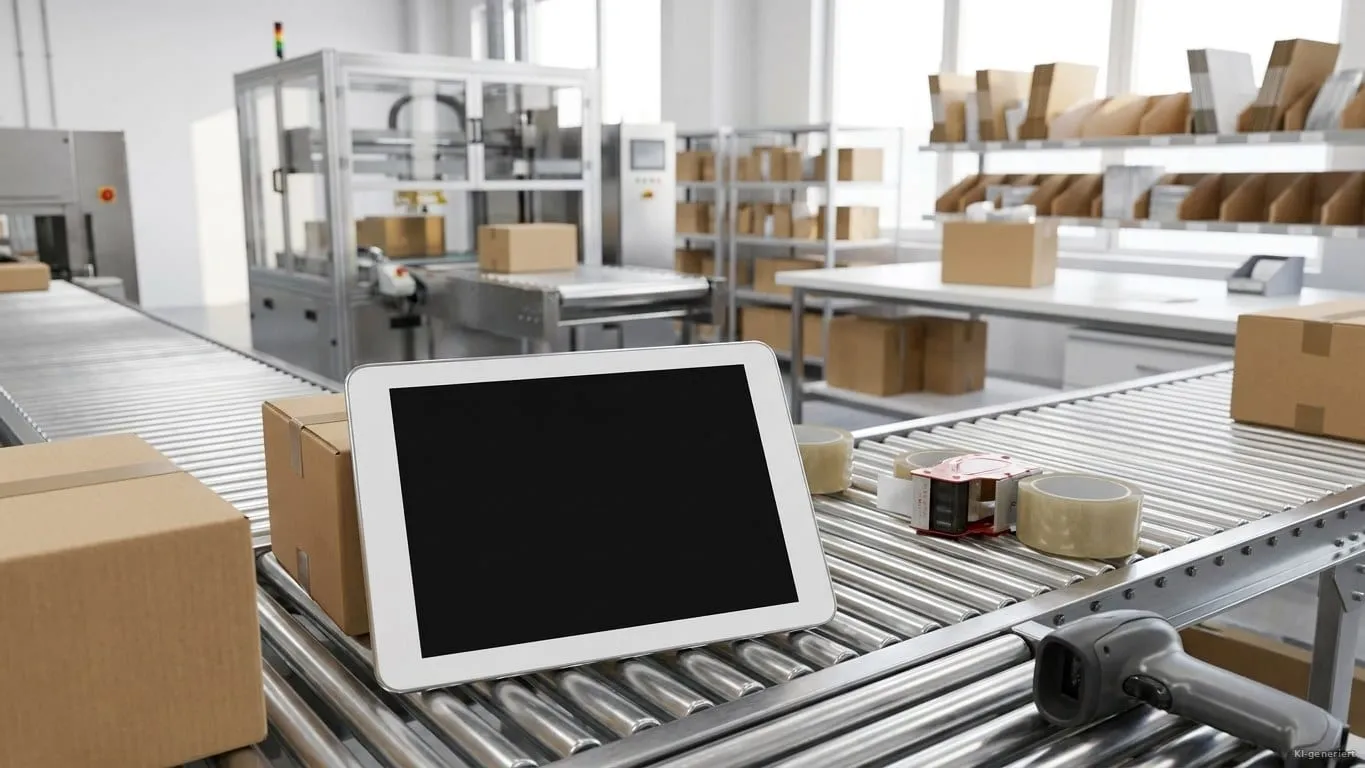
AI and sensors support the optimisation of the packaging process above all in image-based quality inspection, in predictive maintenance and in knowledge transfer at the line. It all starts with a clearly defined problem. Without digital machine data, however, no AI solution will help you either.
In 2024, according to the Federal Statistical Office, 20 per cent of companies with 10 or more employees in Germany used AI, compared with 12 per cent in 2023. Of the companies using AI, 25 per cent deployed it in production or service processes.
Where does AI start when optimising the packaging process?
In its February 2026 report, the packaging technology association PMMI assigns AI to five fields: knowledge transfer, machine vision, predictive maintenance, regulation and compliance, and data transparency.
PMMI sees the greatest momentum in knowledge transfer, that is, the passing on of machine and process knowledge, and in machine vision. Obstacles include hallucinations (incorrect AI outputs), unresolved responsibility for AI errors, cyber security, cost-effectiveness and the existing data infrastructure.
How can AI improve packaging?
According to a summary of the PMMI report, adaptive AI image-processing systems are increasingly replacing rigid inspection systems that often trigger line stops. AI inspection systems reportedly achieve fault detection rates of over 99 per cent and reduce false rejects, that is, good parts wrongly sorted out, by up to 50 per cent. These figures are based on interviews with suppliers and users, not on independent measurements. They are not a guaranteed value for your line.
In addition to camera images, spectral data can also be analysed. A study in the Journal of Imaging examined how deep learning detects faulty seal seams on food trays in hyperspectral images. A convolutional neural network (CNN) performed best of four compared methods, with 90.1 per cent accuracy. Because only the relevant spectral bands were analysed, computing time fell. The value applies only to this experimental set-up and dataset.
What can sensors do for predictive maintenance?
Predictive maintenance relies on IoT sensors and real-time machine data. It learns from this data, predicts faults and provides corrective recommendations. Explainable AI and video recordings during maintenance operations support it.
Not every prediction needs deep learning. A 2025 study determined, for a type of bagging machine using a statistical method based on operational metrics, a probable failure range of 9,090.5 to 12,736.5 operating hours. This almost matches the manufacturer's warranty. According to the authors, timely maintenance could raise the lower limit of the failure range. One possible starting point is therefore to systematically analyse existing operational metrics.
How do you make your packaging process more efficient?
"However, if the digital source data is missing, then an AI solution cannot help either," says Guido Reimann of the mechanical engineering association VDMA. How often data becomes an obstacle is shown by Destatis: of the companies that did not use AI in 2024 but had considered doing so, 45 per cent cited problems with the availability or quality of data and 44 per cent the incompatibility with existing systems.
As a basis for data exchange, the VDMA promotes open standards such as OPC UA and data spaces such as Manufacturing-X. According to the VDMA, AI projects often fail not because of the technology but because of organisation, decision-making structures, a lack of involvement of those concerned and insufficient knowledge. PMMI recommends five steps:
- Identify a specific business or product problem, such as frequent line stops.
- Bring in AI experts and choose the right approach.
- Check system readiness.
- Manage the change and drive the rollout.
- Bring all those involved together.
Not every bottleneck needs AI. In practice, it is also worth looking at the packing station itself: systems for paper cushioning and air cushion packaging produce cushions directly at the packing station as needed, and made-to-measure corrugated boxes ensure a precise fit. We will work out with you which combination suits your processes as part of our industry solutions.
Which rules apply to AI on packaging machines?
The Machinery Regulation (EU) 2023/1230 applies from 20 January 2027 for placing on the market. Annex I Part A Nos. 5 and 6 of the Machinery Regulation covers safety components and systems embedded in machinery with "self-evolving behaviour" based on machine learning that ensure safety functions. According to the DGUV, a conformity assessment procedure under Module B plus C, H or G is envisaged for this. However, the term is not defined and interpretations differ.
For control systems with self-evolving behaviour, according to the DGUV, data on the safety-relevant decision-making process must additionally be recorded and kept available for one year. A log of interventions and software versions must be accessible for up to five years for all safety control systems.
The AI Regulation has been in force since 1 August 2024 and distinguishes four risk levels. High-risk obligations for AI embedded in regulated products apply, according to the EU Commission, from 2 August 2028 following the AI Omnibus. The Omnibus has been in force since 27 July 2026 and also governs the interplay with the Machinery Regulation: according to the Commission for Occupational Health and Safety and Standardisation (KAN), requirements for high-risk AI in machinery are in future to be set out solely in the Machinery Regulation, with the EU Commission laying them down by delegated act.
Which requirements apply to an AI function in your machine depends on the individual case, above all on its safety function. This overview does not replace a technical and legal review.
Related to this article: Nachhaltige Papierpolster-Verpackungen Umweltfreundlich & belastbar: Papierpolstersysteme für ökologischen Versand. Flexibel einsetzbar zum Polstern & Fixieren. Jetzt auf Papier umsteigen! More about Nachhaltige Papierpolster-Verpackungen →
Frequently asked questions
Do existing packaging machines have to be retrofitted from 2027?
According to the DGUV, no. The Machinery Regulation does not create any retrofitting obligation for existing machines; operation is governed by the Occupational Safety and Health Act (Arbeitsschutzgesetz) and the Ordinance on Industrial Safety and Health (Betriebssicherheitsverordnung). You should nonetheless have specific conversion projects reviewed by experts.
Is an AI camera for quality inspection automatically high-risk AI?
This cannot be said across the board. A pure quality inspection without a safety function is likely to be classified differently from an AI safety component. However, there is no binding classification; the individual case is decisive.
Do smaller companies already use AI too?
Less often than large ones: in 2024, according to Destatis, 17 per cent of small and 48 per cent of large companies used AI. According to PMMI, interest in SaaS models, which shift the risk to the supplier, is growing above all among smaller companies.
Does AI save packaging material?
We are not aware of any independent evidence that AI measurably reduces material consumption. In practice, the lever for material lies more in format and cushioning, for example in a precisely fitting box.
Would you like to optimise your packaging process? Let us know briefly what conditions exist at your packing station. Get in touch with us; we will be happy to help you.
Transparency note: This article was created with AI assistance and reviewed by our editorial team. The article image is AI-generated.