
Packaging Foam and Foam Cushions: When They Are the Best Solution for Sensitive Products
· by Editorial team
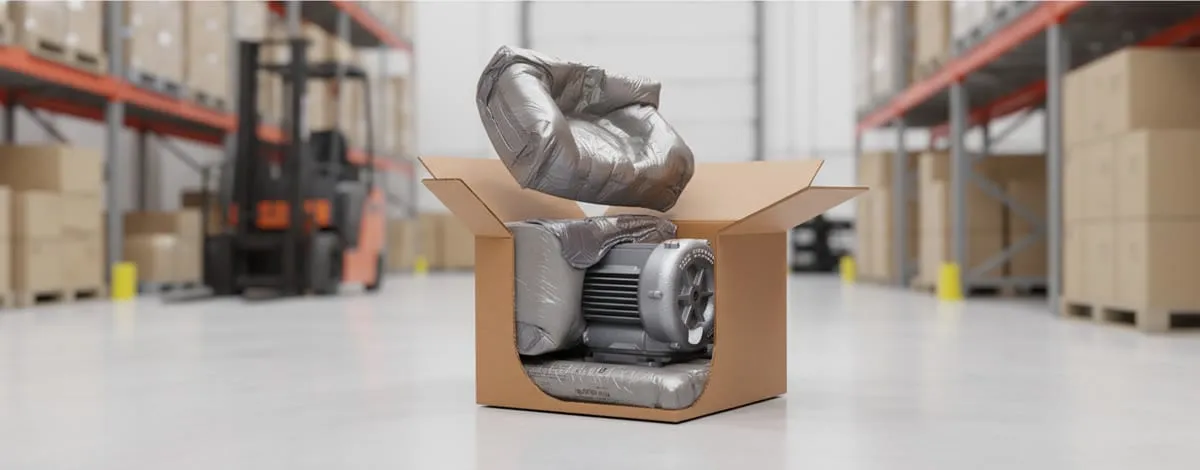
Why standard void fill is not always enough
Many shipping processes start with a simple question: how does the product reach the customer safely? For robust, uniformly shaped items, conventional void fill or cushioning materials are often sufficient. It becomes more difficult when products have sensitive surfaces, are irregularly shaped, are relatively heavy, or need to be held as firmly as possible in the box. In precisely such cases, it is worth taking a closer look at packaging foam and foam cushions.
Foam cushions are not a solution "for everything", but they can be strong when packaging has to do more than just fill voids. They stabilise, cushion and adapt to product contours. For purchasing, logistics and shipping managers, this is particularly relevant when damage, complaints or laborious manual packing processes need to be reduced.
What packaging foam can deliver in shipping
In the B2B environment, packaging foam is used above all where products must be reliably protected during transport, handling and warehouse movements. The central advantage: foam cushions can adapt to the shape of the product and hold it in place in the shipping box. This creates not only cushioning but also targeted stabilisation.
This is of particular interest for components, devices, spare parts, electronic components or products with complex geometries. When an item shifts in the box, stress often arises not from a single heavy impact but from repeated movement, edge contact or pressure points. A suitable foam cushion can reduce precisely these risks.
FUCHSPACK brings the corresponding solutions together in the foam packaging section. The focus there is on applications in which product protection, process reliability and a clean packaging solution have to be considered together.
When foam cushions make particular sense
Foam cushions are worth considering above all when at least one of these points applies:
- The product is sensitive to shocks, pressure or surface contact.
- The shape is irregular and difficult to stabilise with standard material.
- The value of the goods is high and transport damage would be particularly costly.
- Packers need a repeatable, traceable solution.
- Complaints or repacking are already causing noticeable effort.
- Products are to be not just surrounded in the box but positioned deliberately.
Especially with smaller production runs, changing product sizes or industrial goods that require explanation, packaging foam can be a practical solution. It helps to combine protection and process flexibility without having to develop a fully customised packaging for every product straight away.
Packaging foam, paper cushions or air cushions: the decision depends on the product
Whether packaging foam is the best solution is not decided by the material alone. The decisive factors are product weight, sensitivity, geometry, shipping route, packaging process and the desired level of protection. Air cushions can be very efficient for void fill and lightweight products. Paper cushions are often of interest when flexible filling or a different material feel is required. Foam cushions come more strongly into play when retention, adaptation to contours and shock absorption are the priority.
That is why the selection should not be made in isolation. In many companies, packaging problems arise because one material is used across the board for too many applications. It makes more sense to look at product groups: Which items need only void fill? Which need edge protection? Which have to be stabilised with a form-fitting solution? And where is foam packaging cost-effective because it reduces damage or process effort?
FUCHSPACK therefore does not regard packaging solutions merely as a question of material. It is about bringing together protection requirements, handling and the reality of shipping.
Matching product: Foam cushions & made-to-measure foam packaging | FUCHSPACK INSTAPAK® foam packaging for maximum product protection. Expanding cushions for complex geometries. Efficient, safe and shock-resistant. Find out more here! More about foam cushions & made-to-measure foam packaging | FUCHSPACK →
Related to this article: Schaumpolster & Schaumverpackungen nach Maß | FUCHSPACK INSTAPAK® Schaumverpackungen für maximalen Produktschutz. Expandierende Polster für komplexe Geometrien. Effizient, sicher & stoßfest. Hier informieren! More about Schaumpolster & Schaumverpackungen nach Maß | FUCHSPACK →
Practical example: complex shapes and changing product sizes
The benefit becomes particularly clear with products that do not have a simple rectangular shape. A device with protruding parts, a sensitive spare part or a component with a painted surface can quickly be stressed at critical points in the box. If only loose void fill is used, it often remains unclear whether the product actually sits stably after packing.
Foam cushions can help here because they hold the product in a more controlled way and reduce movement in the box. For shipping teams, this is an important point: a packaging solution must not only protect in theory but work reproducibly in everyday operation. If different employees are expected to achieve similarly good results, a clear, suitable cushioning solution is an advantage.
For automated or semi-automated processes, it can also be relevant how quickly and consistently packaging foam is processed. Examples of corresponding systems can be found, among others, at INSTAPAK® SpeedyPacker or, for manual solutions, at INSTAPAK® QuickRT. Which variant fits, however, always depends on the product, quantity and workflow.
What companies should consider before deciding
Before packaging foam is introduced or an existing packaging process is changed, a few questions should be clarified:
- Which products currently cause the most damage or rework?
- Is the primary concern shock protection, retention, surface protection or process speed?
- How much do product sizes and packaging units vary?
- Which employees pack the products, and how standardised does the workflow need to be?
- Which existing boxes, packing stations or systems are to continue in use?
- Are there alternative solutions that are better suited to certain product groups?
These questions prevent packaging foam from being viewed as an isolated material decision. In many cases, the best solution only emerges from the interplay of product analysis, packing trials and a process perspective.
Conclusion: foam cushions are strong when protection and fit count
Packaging foam and foam cushions make particular sense when products are sensitive, valuable, irregularly shaped or difficult to hold in place reliably. They can help to reduce transport damage, stabilise packaging processes and prepare products professionally for shipping.
At the same time: not every product needs foam. The best packaging solution comes from carefully weighing up protection requirements, material, handling and cost-effectiveness. This is exactly where FUCHSPACK comes in, with a focus on the specific application rather than on one-size-fits-all standard solutions.