Packaging consultation: how do you get from the first idea to the right solution?
· by Editorial team
A packaging consultation guides you in clear steps from taking stock to a solution: analyse products and packing station, weigh up protection and material use, select suitable boxes and cushioning systems, test and roll out. This helps you optimise your packaging in a targeted way and prepare for the requirements of the EU Packaging and Packaging Waste Regulation.
When is a packaging consultation worthwhile?
Typical triggers are recurring transit damage, a growing mix of box formats, a lot of void fill per parcel or a packing station that becomes a bottleneck as volumes rise. A new product or a new sales channel is also a good moment to review your packaging from the ground up.
The German Environment Agency (Umweltbundesamt) names mail order as one driver of more packaging: consumption rises when additional and heavier shipping packaging is not offset by carrier bags that are no longer needed. According to the agency, individual packaging becoming lighter is one factor that reduces consumption. For plastic packaging, avoidance and the switch to paper, paper composites and aluminium are added to this. These are exactly the levers a consultation addresses.
The legal framework also plays a part. Since 12 August 2026, packaging law in Germany has been governed by the EU Packaging and Packaging Waste Regulation (PPWR) and the Packaging Law Implementation Act (Verpackungsrecht-Durchführungsgesetz, VerpackDG). The old German Packaging Act (VerpackG) is no longer in force. By 1 January 2030, producers and importers must reduce packaging by weight and volume to the minimum required for its function.
How does a consultation at Fuchspack work?
From the first idea to the finished solution, we proceed in five steps:
- Clarify requirements: You tell us what you ship, in what quantities, and where things are going wrong today.
- Packaging analysis: We review products, dimensions, weights and sensitivity, as well as boxes, void fill and processes at the packing station, if you wish during an on-site consultation.
- Develop a concept: A solution for your products is created from made-to-measure corrugated boxes and suitable cushioning systems. For mechanical engineering, medical technology or online retail, our industry solutions bundle typical requirements.
- Test and calculate: We test the solution with your products. A cost-benefit calculation compares material, time spent and storage requirements with the current situation.
- Roll out and document: The new packaging passes into your packing process. We record why the box size and cushioning were chosen as they were and what the tests revealed.
This documentation helps in two ways. Under Article 10 PPWR, packaging minimisation must be demonstrated in technical documentation, for example with test results, modelling or simulations and with a justification of why less weight or volume is not possible. A systematic packaging analysis provides the technical basis for this; it does not replace a legal review.
How can the packaging process be optimised without weakening protection?
Anyone wanting to optimise packaging often thinks first of using less material. However, in the Journal of Industrial Ecology (2019), Wikström and colleagues describe a conflict of objectives for food between product protection and shelf life on the one hand and the environmental footprint of the packaging on the other: less packaging can lead to more product losses. In our experience, shipping is similar. Saved material achieves little if the goods arrive damaged.
An effective lever is a precise fit. Under the PPWR, void fill such as paper, air cushions or foam counts as empty space (void). A perfectly fitting box therefore helps the void ratio more than additional cushioning. For grouped, transit and e-commerce packaging, a void ratio of no more than 50 % applies from 1 January 2030 at the earliest.
Cushioning should protect the product, not compensate for a box that is too large. Which one is suitable depends on weight, shape and sensitivity: paper cushions cushion and secure, air cushions fill voids, foam cushions adapt to complex geometries. Suspension packaging holds sensitive products in position, and airbag packaging protects items such as laptops on all sides.
At the packing station, short distances, a sensible number of box formats and the question of whether cushioning is kept in stock or produced only when needed also matter.
Related to this article: Versandkartons & Kartonagen nach Maß Stabile Faltkartons und individuelle Kartonagen für jeden Einsatzzweck. Passgenaue Lösungen reduzieren Versandkosten & Schäden. Jetzt Angebot anfordern! More about Versandkartons & Kartonagen nach Maß →
What does a packaging consultation cost?
Flat-rate prices cannot be quoted responsibly. The effort depends on how many products and shipping routes are considered, whether an on-site consultation makes sense and how many tests are needed. We agree the scope with you in advance.
Small and medium-sized enterprises can obtain a subsidy for external business consulting from the Federal Office for Economic Affairs and Export Control (Bundesamt für Wirtschaft und Ausfuhrkontrolle, BAFA). Up to 3,500 euros in consulting costs per consultation are eligible for funding. The subsidy is 50 % in the former West German states, up to a maximum of 1,750 euros. In the former East German states (excluding Berlin and the Leipzig region) as well as in the Lüneburg and Trier regions, it is 80 %, up to a maximum of 2,800 euros. The following applies:
- The guideline is limited until 31 December 2026. The BAFA has not announced an extension.
- The application must be submitted before the contract is concluded, as the conclusion of the contract itself counts as the start of the consultation.
Only consultations by consulting firms registered with the BAFA, whose business consists predominantly of business consulting, are eligible for funding. Consultations that serve to sell the consultant's own goods or services are excluded. As a packaging provider, our packaging consultation therefore probably does not fall under this funding. To find out whether an independent consultation is eligible for funding for your project, it is best to clarify this in advance with the BAFA or your Chamber of Industry and Commerce (IHK).
Frequently asked questions
What does a packaging consultant do?
A packaging consultant analyses products, packaging and packing processes, weighs up product protection against material use and proposes suitable solutions. With us, analysis and implementation are in one hand.
Which documents help at the first meeting?
Useful items are a product list with dimensions and weights, your current box formats, approximate shipping volumes, photos of the packing station and examples of transit damage.
Does the 50 % void limit already apply today?
No. The limit applies from 1 January 2030 or three years after the implementing acts enter into force, whichever is later. There is no percentage limit for sales packaging: here, the void must be limited by 12 February 2028 to the minimum required for the packaging functions, including product protection. Since the EU Commission will not set the calculation method until that date, statements about individual packaging are only possible subject to reservation.
Does the packaging consultation replace a legal review?
No. We give you a technical assessment of material, volume and product protection. Whether a packaging meets the requirements of the PPWR and VerpackDG should be reviewed by a legal expert.
Your next step: Use the contact to the packaging specialist to tell us briefly what you ship and what conditions apply. Together we will clarify how your packaging consultation can best begin.
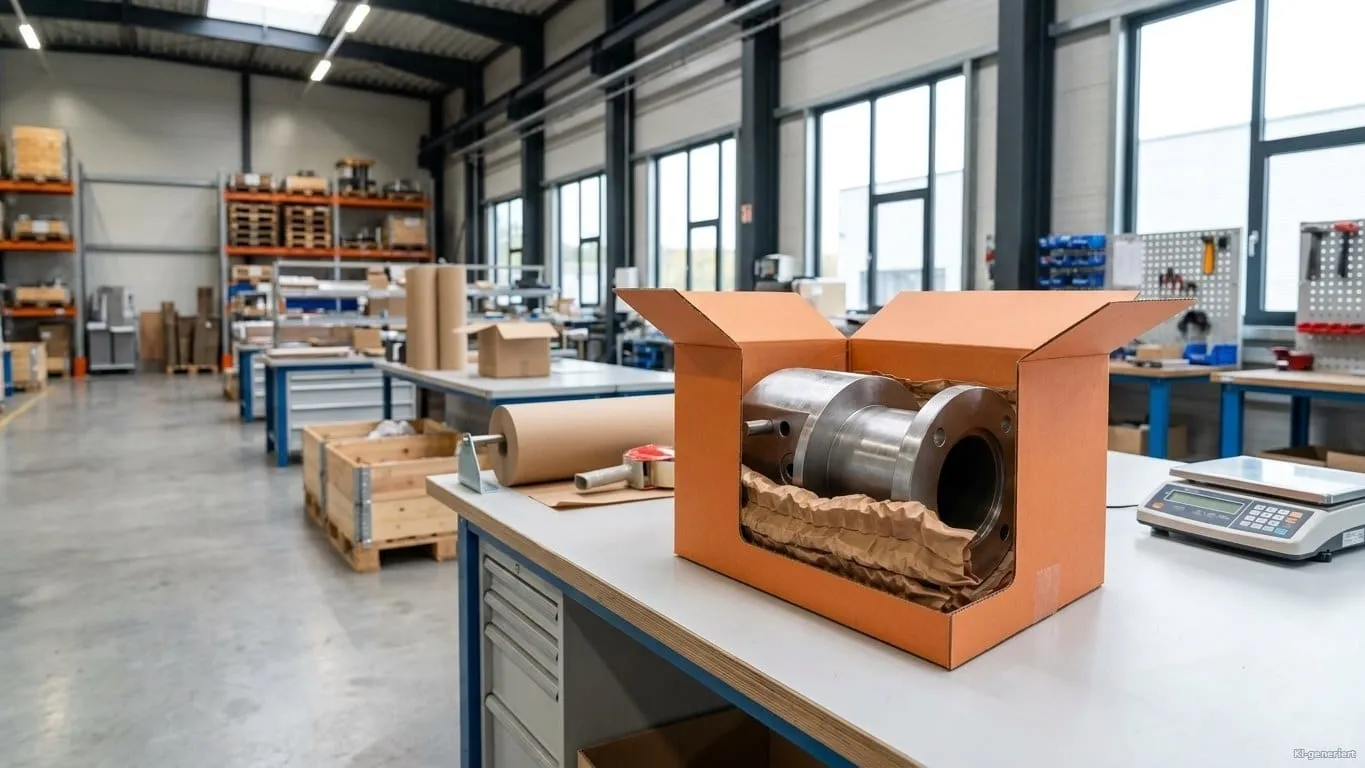
Transparency note: This article was created with AI assistance and reviewed by our editorial team. The article image is AI-generated.