
Foam packaging: how do you protect fragile goods in transit?
· by Editorial team
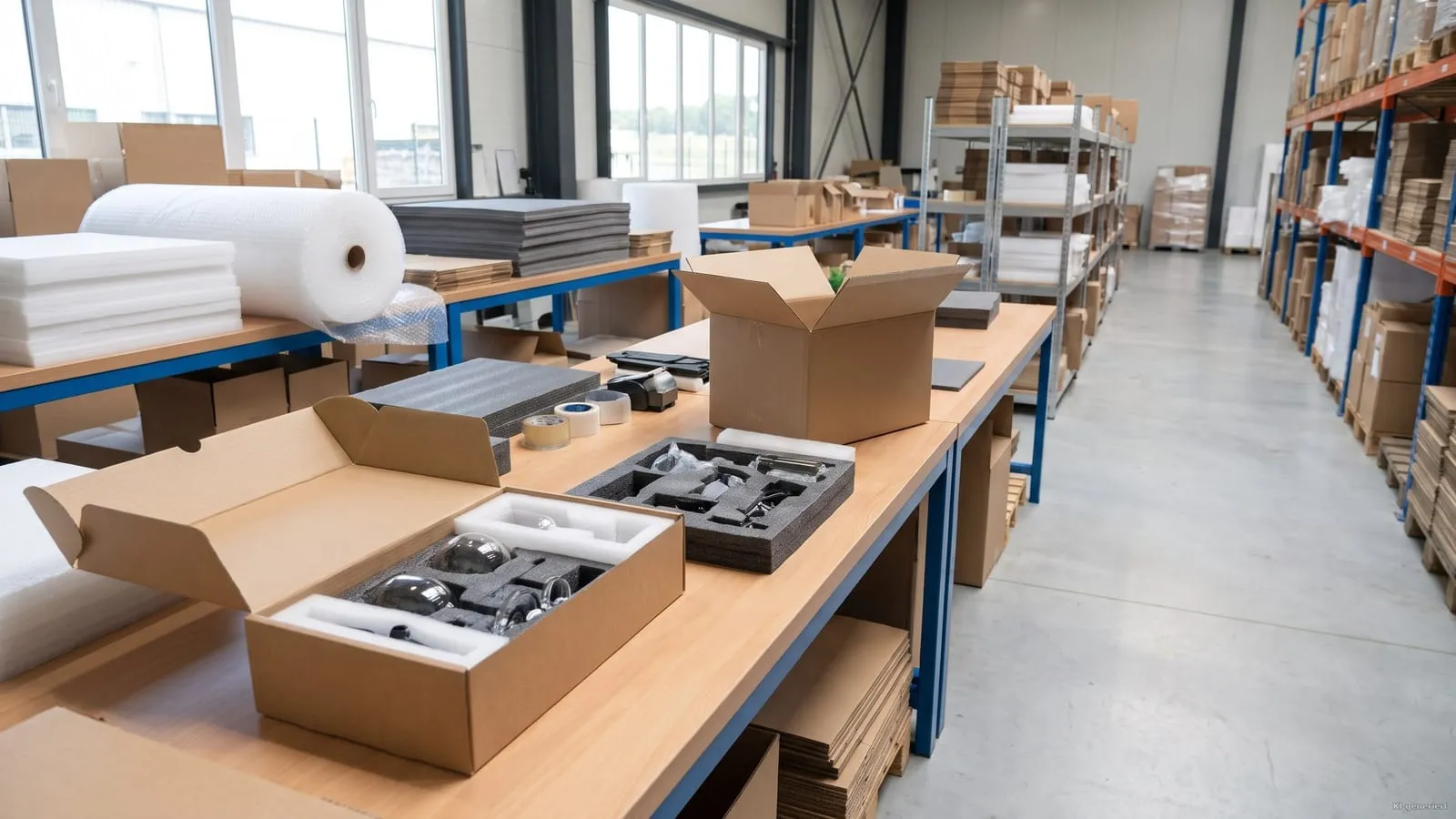
Foam packaging protects fragile goods when the product sits centrally in the box, is cushioned all round and cannot move. How thick the cushion must be depends on product weight, contact area and potential drop height. Reliable answers come from measured values and transit tests.
How do you pack fragile items correctly?
The basic rules apply to every cushioning material. In its shipping advice, DHL Express recommends the following:
- Position centrally: The product belongs in the middle of the box, with at least 6 cm of clearance from outer walls and corners. This is the recommendation of a shipping provider, not a standard.
- Fill voids: The space in between is fully cushioned so that the contents cannot move during transit.
- Choose a sturdy box: For fragile or heavy goods, DHL Express advises double- or triple-wall corrugated board.
- Separate parts: Where several items share one parcel, separate them with dividers so they do not knock against each other.
- No used boxes: They may have lost rigidity.
A foam cushion can handle two of these tasks at once: it keeps the product away from the box wall and holds it in place. For this to work, the box must match the product, for example as made-to-measure corrugated boxes.
How thick does foam packaging need to be?
There is no minimum thickness that applies to all products. Whether a foam cushion is sufficient depends on three values: the static load, meaning the product weight per contact area, the cushion thickness and the drop height.
Traditionally, the shock absorption of a cushioning material is determined using cushion curves to the ASTM D1596 industry standard. They show how much shock the material passes on to the product for a given combination of load, thickness and drop height. This requires many drop tests, which costs time and material.
Calculation methods such as the stress-energy method combine drop height, thickness and load in a single equation and are intended to require considerably fewer tests. However, a study in the Journal of Testing and Evaluation found larger errors than the ±5 % stated previously. For thin cushions, high static loads and large drop heights, only measured values are reliable.
For your practice, this means: where the load per contact area is high, the cushion is thin or the potential drop height is large, do not rely on estimated values.
How do you check whether your packaging survives shipping?
Standardised transit simulations are available from the International Safe Transit Association (ISTA) for parcel shipments. Test series 1 is a pure integrity test without simulation. The 3 series reproduces transit stresses, such as drop shocks from varying heights, random vibration and climate conditioning. ISTA 3A is aimed at individually packaged products in parcel delivery up to 70 kg.
This shows you whether product, cushion and box work together before you permanently change your packaging.
Which foam cushions suit your packing process?
The foam packaging from FUCHSPACK works with INSTAPAK®: the foam expands and conforms even to complex geometries. Which system fits depends above all on your shipping volume:
- Fluctuating demand: With INSTAPAK® QuickRT, you activate foam bags at the push of a button, entirely without equipment.
- Small to medium quantities: INSTAPAK® Tabletop is a space-saving machine that is easy to operate.
- High throughput: INSTAPAK® SpeedyPacker produces foam bags fully automatically.
- Precise moulded cushions: INSTAPAK® iMold produces moulded foam cushions for your products automatically.
- Manual foam-in-place: INSTAPAK® 901 is used for precise void filling and retention.
For sensitive product groups such as sanitary ware and ceramics, electronics or medical technology, our industry solutions bring together suitable concepts.
Related to this article: Schaumpolster & Schaumverpackungen nach Maß INSTAPAK® Schaumverpackungen für maximalen Produktschutz. Expandierende Polster für komplexe Geometrien. Effizient, sicher & stoßfest. Hier informieren! More about Schaumpolster & Schaumverpackungen nach Maß →
What does the EU Packaging and Packaging Waste Regulation mean for foam cushions?
The EU Packaging and Packaging Waste Regulation (PPWR) limits empty space (void): anyone filling transport, grouped or e-commerce packaging must ensure that the empty space ratio is no more than 50 %. This applies from 1 January 2030 or, if later, three years after the implementing acts on the calculation method enter into force.
Void fill such as foam, air cushions, paper or polystyrene is expressly counted as empty space (void). Switching the void fill therefore does not improve the ratio. Precisely fitted foam inserts become relevant where they replace loose filling in oversized boxes: they affect the empty space ratio through the box size.
The European Commission will set the calculation method by 12 February 2028, taking into account sensitive products and irregular shapes. Binding calculation examples are therefore not yet available. The German Environment Agency (Umweltbundesamt) recommends using only as much cushioning material as is necessary for product protection, and points out that oversized shipping packaging often requires a great deal of it. This guidance does not replace legal advice.
Frequently asked questions
Which cushioning material is suitable for shipping?
This depends on the weight, shape and sensitivity of the product, as well as on your packing process. A blanket ranking of the materials cannot be drawn up credibly. Alongside foam cushions for complex shapes, we offer air cushion systems for void filling, paper cushioning for cushioning and holding in place, and suspension packaging for sensitive products.
Can foam be recycled?
That depends on the plastic. According to the German Environment Agency (Umweltbundesamt), polyethylene (PE) and polypropylene (PP) can be recycled well when sorted by type, and the plastic type should be stated on the packaging. For EPS, the picture is mixed: according to a study commissioned by the Industrieverband Hartschaum, the recycling rate in Germany in 2021 was 83 % for EPS packaging from industry and commerce, and 6 % for household-related packaging. According to the trade publication EUWID, the guidance from the Central Agency Packaging Register (Zentrale Stelle Verpackungsregister) classifies EPS as not recyclable.
Are biodegradable plastics the better choice?
According to the German Environment Agency (Umweltbundesamt), no: shipping packaging made from biodegradable plastics shows no overall ecological advantages over conventional plastics in any disposal route.
Which obligations apply to packaging in Germany?
According to the German Environment Agency (Umweltbundesamt), anyone placing packaging on the market for the first time must observe the obligations under the Packaging Law Implementation Act (Verpackungsrecht-Durchführungsgesetz, VerpackDG) and the PPWR. On 15 June 2026, the Central Agency Packaging Register (Zentrale Stelle Verpackungsregister, ZSVR) launched a consultation on the new catalogue of packaging subject to system participation. Whether your void fill is affected should be clarified case by case with the ZSVR or a legal adviser.
Find the right foam packaging: Tell us about your product, weight and shipping route via the contact with our packaging specialists. Together we will find the combination of cushion and box that suits your goods.
Transparency note: This article was created with AI assistance and reviewed by our editorial team. The article image is AI-generated.