
Fill Air Rocket: How does the air cushion system work at the packing station?
· by Editorial team
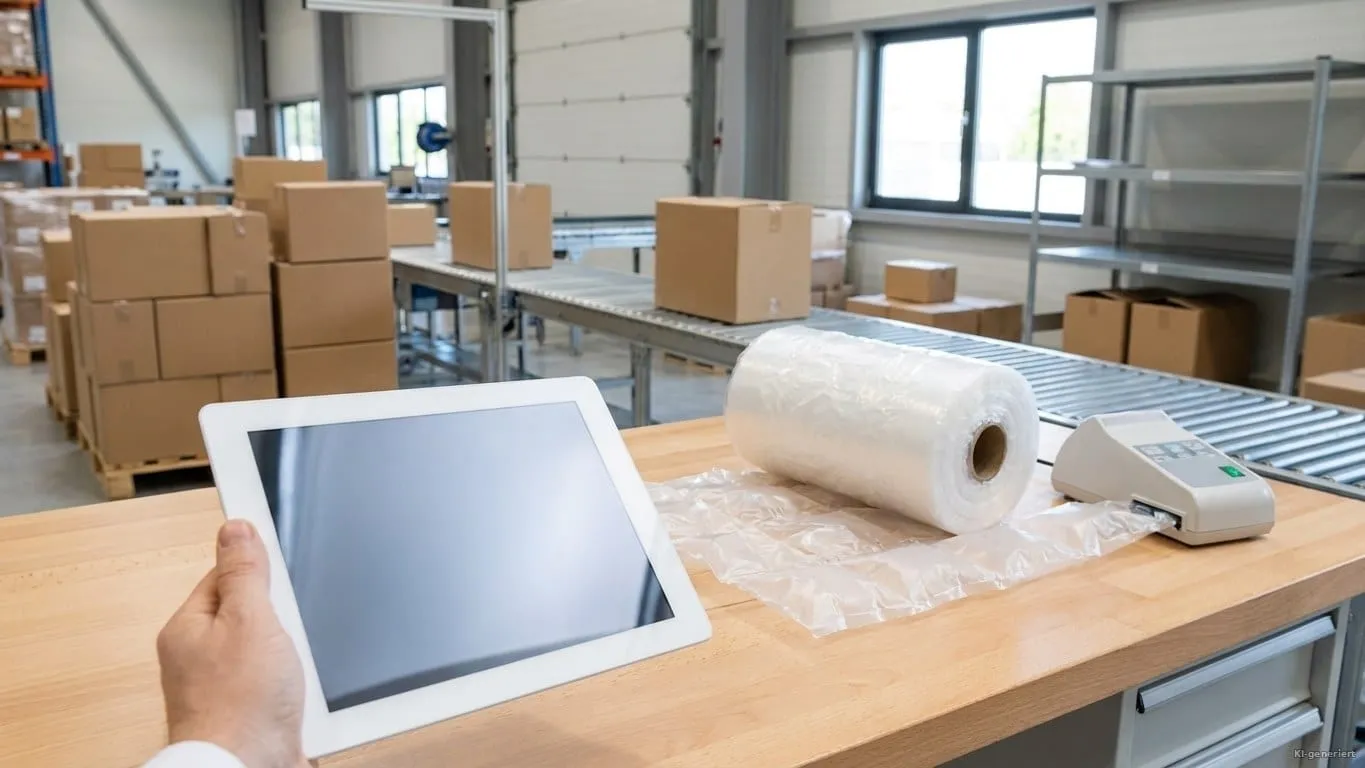
The Fill Air Rocket inflates pre-converted film into air cushions at the packing station and seals them, with sensors detecting every cross-seal. According to a trade report, it processes up to 100 feet of film per minute. Thanks to its quick start, you do not always have to produce void fill cushions in advance.
The Fill Air Rocket is part of our air cushion packaging and produces void fill cushions exactly where you pack. Such devices are often referred to as an air cushion machine.
How does an air cushion machine like the Fill Air Rocket work?
If you are looking for a machine for bubble wrap, you often mean a system like this one. In the strict sense, bubble wrap is the film with air bubbles used for wrapping. The Rocket, by contrast, produces air cushions, in other words void fill for empty spaces in the box.
The principle behind Fill Air is quickly explained: the machine inflates pre-converted film and seals it. This creates individual cushions that you place directly into the shipping box. According to the trade report, three functions control the process:
- Sensors detect every cross-seal and automatically stop and start the machine there.
- An automatic edge alignment guides the film.
- A spring-loaded tension control regulates the film tension.
According to the manufacturer in the same report, it is above all precise sealing that determines the performance of the air cushions.
What performance data does the Fill Air Rocket have?
The following figures come from two trade reports from 2013 and are based on manufacturer information. They are maximum values, not independently measured values.
- Speed: 100 feet of film per minute, equivalent to around 30.5 metres.
- Quiet mode: In Quiet Mode, the operating noise is reduced. The machine then still fills 65 feet of film per minute, around 19.8 metres.
- Quick start: In the first 20 seconds, three times as many bags are produced as with the predecessor system.
- Films: the Fill-Air Extreme and Fill-Air Extreme Efficiency types, in widths of 8, 10 and 12 inches and with cushion lengths of 5 and 8 inches.
In everyday packing, the quick start is particularly interesting. Because bag production begins immediately, you do not always have to pre-produce and store void fill cushions. For shipping departments in online retail with many different consignments, void fill on demand is therefore a practical approach. We will work together with you to determine which version and which films suit your application today.
Which void fill is suitable for parcels?
We are not aware of any official ranking of void fill materials. However, the German Environment Agency (Umweltbundesamt, UBA) sets out clear principles: use cushioning material only where there is an actual need for protection and only in the necessary quantity, choose PE or PP instead of PVC, use only one type of material where possible and increase the recycled content. The UBA advises against biodegradable plastics because they offer no advantages in any disposal route.
The first lever is therefore the box. According to the UBA, oversized shipping packaging uses up resources unnecessarily and requires more cushioning material. With made-to-measure corrugated boxes, you reduce the empty space before you fill it.
After that, the product decides in practice:
- Air cushion packaging is intended for filling empty spaces.
- Paper cushions can be used flexibly for cushioning and holding items in place.
- Foam cushions are suitable for complex geometries.
We will determine which combination suits your goods based on the specific product.
Related to this article: Fill Air Rocket Bis zu 30 Meter Luftkissen pro Minute. Das Fill Air Rocket System ist kompakt, schnell und perfekt für den modernen E-Commerce. Hier informieren! More about Fill Air Rocket →
What does the PPWR mean for void fill made of air cushions?
Since 12 August 2026, the EU Packaging and Packaging Waste Regulation (PPWR) and the Packaging Law Implementation Act (Verpackungsrecht-Durchführungsgesetz, VerpackDG) have applied in Germany. They have replaced the previous German Packaging Act (VerpackG). Registration in the LUCID packaging register, participation in a system and data reporting remain mandatory. For air cushions, three points are important:
- Void fill counts as packaging. The Central Agency Packaging Register (Zentrale Stelle Verpackungsregister, ZSVR) attributes void fill materials such as plastic films to the packaging. According to the ZSVR, shipping packaging including void fill is subject to system participation.
- Air cushions count as empty space. Under Art. 24(3) PPWR, space filled with air cushions, bubble wrap or paper counts as empty space (void). For e-commerce packaging as well as for transport and grouped packaging, the empty space ratio may be no more than 50 %. The obligation applies to companies that fill such packaging. It takes effect from 1 January 2030 or three years after the implementing act on the calculation method enters into force, whichever is later. The European Commission will set this method by 12 February 2028. Air cushions therefore do not make an oversized box legally compliant.
- Anyone adding void fill may become a producer. If you add void fill to packaging that is already complete and this affects its conformity or recyclability, you are deemed to be the producer of that packaging under Art. 21 PPWR according to the ZSVR.
In addition, under Art. 10 PPWR, from 1 January 2030 the weight and volume of packaging must be reduced to the minimum required for its function. This overview does not replace legal advice. Which obligations specifically apply to you depends on the individual case and should be reviewed legally.
Frequently asked questions
How fast does the Fill Air Rocket work?
According to trade reports from 2013, it processes up to 100 feet of film per minute, around 30.5 metres. In quiet mode it is 65 feet, around 19.8 metres. Both are manufacturer figures and maximum values.
Do air cushions compensate for an oversized box?
No. Under the PPWR, space filled with air cushions counts as empty space. The right box size is therefore the first step; the void fill comes afterwards.
Do you have to produce air cushions in advance?
Not in every case. Thanks to the quick start function, bag production begins immediately. In some cases, this removes the need to pre-produce and store the cushions.
Do air cushions belong to the packaging?
The ZSVR counts void fill materials such as plastic films as packaging, although it does not explicitly mention air cushions. Shipping packaging including void fill is subject to system participation. You should have your specific situation reviewed on a case-by-case basis.
Are you considering whether the Fill Air Rocket suits your packing station? Briefly describe the conditions you have and we will be happy to help you: Contact the packaging specialist.
Transparency note: This article was created with AI assistance and reviewed by our editorial team. The article image is AI-generated.