
Buying packaging material: when a suspension pad pays off
· by Editorial team
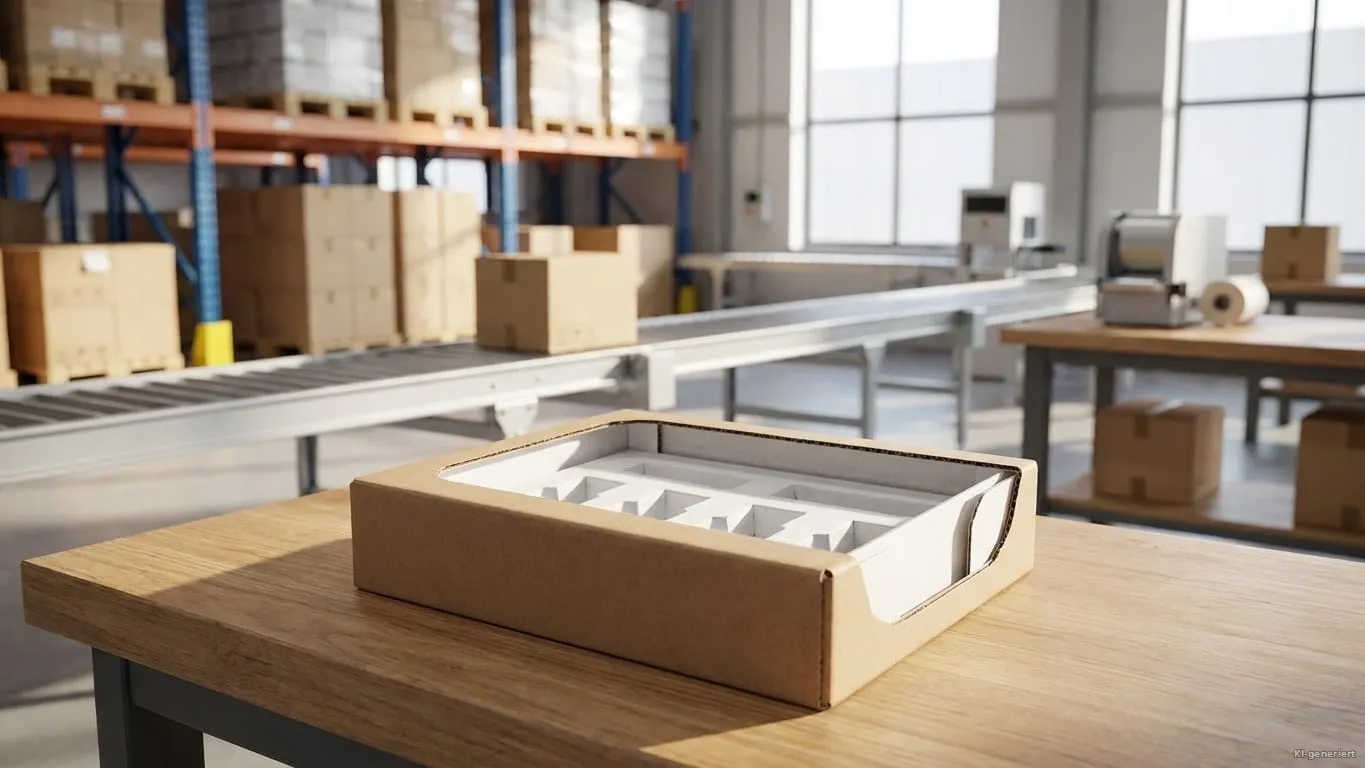
If you buy packaging material and ship sensitive, relatively light products, suspension packaging pays off: a tensioned film holds the goods in the box and loose void fill is no longer needed. With heavy goods the principle reaches its limits, and other cushioning systems then come into play.
Suspension packaging does not fill a void, it secures the product itself. We offer suspension packaging and retention packaging for sensitive products. Our article „Polstermaterial im Versand: Wie schützen Sie Ware mit weniger Material?“ shows you how to use conventional void fill more sparingly.
How does suspension packaging work?
The product sits between two layers of corrugated board with highly elastic film windows made of PE or PU, and the whole assembly fits into a precisely matched outer box. When an impact hits the parcel, the tensioned film gives way and converts it into an oscillation that does not harm the product. This is why it is referred to as the trampoline principle.
A specialist article in packaging journal describes two further designs:
- Retention packaging: The product is pushed between a corrugated board tray and a film. When the side wings are folded over, the film tensions and holds the goods in position.
- Paper-based variant: A laser-cut mesh structure in the box takes over the role of the film, according to the article for products up to 1 kg.
In all cases, loose void fill such as bubble wrap, foam or polystyrene chips is no longer needed. According to the specialist article, the packaging consists of at least 95 per cent corrugated board.
Which products are suited to suspension packaging?
Suspension packaging suits sensitive individual items that need to arrive secured and without shifting, for example in medical technology or with electronics. According to the specialist article, one size can hold several products of similar size. This reduces the effort in purchasing, warehousing and at the packing station and lowers packing errors caused by too many variants. In online retail with many single shipments, this is also an argument.
Where are the limits?
A peer-reviewed study from 2024 shows that on impact the product moves towards the side of the box, and cushioning effect is lost in the process. A simple rectangular tray only protects light goods against several drops in succession in the same direction. Additional film or wrap layers do not extend the usable weight range. The authors assess a central narrowing of the tray as promising.
Weight limits therefore depend on the manufacturer and the design. The specialist article cites a load capacity of up to 30 kg, which is a manufacturer specification and not a general limit. For heavy goods we have our own packaging for mechanical engineering.
Packaging material made of board and film: what applies under the PPWR?
Since 12 August 2026, the EU Packaging and Packaging Waste Regulation (PPWR) has applied, and the Packaging Law Implementation Act (Verpackungsrecht-Durchführungsgesetz, VerpackDG) replaces the previous German Packaging Act (Verpackungsgesetz). The following points reflect the state of the sources and are not a substitute for legal advice.
Empty space (void): Space with void fill such as paper, bubble wrap or foam counts as empty space (void) under the PPWR. For transit and e-commerce packaging, the empty space ratio may not exceed 50 %, from 1 January 2030 or three years after the implementing acts. The later date is decisive.
No automatic result: Empty space is the difference between the total volume of the packaging and the volume of the sales packaging it contains. The air space in which the product floats in the suspension packaging can therefore also count as empty space. The European Commission will set the calculation method by 12 February 2028.
Recycling: Packaging must be recyclable, from 2030 only performance grades A to C are permitted, and from 2038 only A or B. The claim that suspension packaging can be recycled without separating the film is a manufacturer specification from the specialist article. The Commission has yet to set the criteria for this.
System participation: In Germany, shipping packaging is subject to system participation without exception. This also includes void fill, labels and adhesive tape, so for suspension packaging it covers the board and the film. Anyone distributing packaged goods in Germany must be registered in the LUCID packaging register and report quantities. These obligations generally apply to the party placing the filled packaging on the market. Whether you are affected in an individual case is best clarified with the Stiftung Zentrale Stelle Verpackungsregister.
Related to this article: Membranpolster & Fixierverpackungen Sicherer Halt für empfindliche Produkte. Membranpolster-Fixierung schützt vor Erschütterungen ohne Verrutschen. Ideal für Medizintechnik & Elektronik. More about Membranpolster & Fixierverpackungen →
What should you look out for when buying packaging material?
Suspension packaging is a system made up of a cushion and an outer box. Clarify the following before ordering:
- Product data: Dimensions, weight and sensitive points determine the design.
- Variants: How many articles of similar size does one cushion size cover?
- Packing process: Does the handling step, for example inserting and folding over with retention packaging, fit your cycle time at the packing station?
- Outer box: The cushion needs a precisely matched outer box. Plan the board packaging material accordingly, for example via our made-to-measure corrugated boxes.
- Transit test: Simulation tests such as ISTA 3A replicate, among other things, vibration, drop tests and climatic conditioning for individual packages up to 70 kg in parcel delivery.
If suspension packaging is not the right fit, compare it with air cushions, paper cushions or foam cushions.
Frequently asked questions
Does suspension packaging need additional void fill?
No. Impact protection and retention come from the tensioned film, and in the paper-based variant from the mesh structure in the box.
Can suspension packaging be reused?
According to the specialist article, the components are robust enough for repeated use, which is a manufacturer specification. How many cycles are possible depends on the product and the handling. Check the film and the box for damage before each use.
Does suspension packaging automatically meet the PPWR empty space limit?
This is not established. The space around the product can count as empty space. The decisive factor is the calculation method that the European Commission will set by 12 February 2028.
How do you check whether suspension packaging is enough for your product?
Test the packaging with your original product. Procedures such as ISTA 3A simulate the stresses of parcel delivery in the lab. With heavier products, watch out for repeated drops in the same direction, where the study shows the limits of simple trays.
Would you like to buy packaging material that suits your product? Write to us with the dimensions, weight and shipping route. We will help you select the cushioning solution and prepare a quote for you.
Transparency note: This article was created with AI assistance and reviewed by our editorial team. The article image is AI-generated.